A house can fit your budget and still miss the mortgage rules by one dollar. That is the first thing I tell buyers when they ask about Florida loan limits in 2026. Every buyer should understand that these figures are governed by a specific baseline limit, which acts as the initial benchmark for your financing options before local variables are applied.
I see a lot of confusion around this. People hear one number for FHA, another for a conventional mortgage, and then somebody throws in the term jumbo, making the entire process sound more complicated than it actually is. It does not have to be this way.
Once I separate the county, the loan program, and the actual loan amount, the picture gets much clearer.
Key Takeaways
- Limits apply to loan amounts, not home prices: The mortgage cap is calculated based on the actual loan amount after your down payment, meaning you can often buy a home listed above the limit if you have a sufficient down payment.
- Location dictates the ceiling: While most Florida counties follow standard conforming loan limits, Monroe County is designated as a high-cost area with significantly higher caps for both conventional and FHA financing.
- Jumbo loans start at the limit: A jumbo loan is not a specific, standalone number; it is any mortgage that exceeds the local conforming loan limit for that specific county and property type.
- Limits are just the first gate: Qualifying for a loan requires more than staying under the cap; lenders also evaluate your debt-to-income ratio, inclusive of Florida-specific costs like wind and flood insurance, as well as property-specific factors like HOA health and cash reserves.
What loan limits in Florida actually cap
When I talk about loan limits, I am talking about the maximum loan amount allowed under a given program in a given area. The cap is on the mortgage itself, not on the sales price of the home.
That difference matters more than most buyers expect. If you buy a $900,000 home and put 10 percent down, your loan amount is $810,000. In most Florida counties, that still fits under the 2026 conventional conforming limit. The home price is high, but the loan stays under the cap.
I like to explain it in plain English. The limit follows the size of the loan, not the sticker price on the listing. For 2026, most buyers in Florida are looking at three basic categories. Conventional conforming loans follow the conforming loan limits set for loans that fit agency guidelines. FHA loans have their own county caps. Jumbo loans start once the loan amount goes over the local conforming ceiling.
The county is where this gets interesting, as these limits are often tied to the local median home price. Florida does not have one uniform market. Most counties use the standard 2026 numbers for a single-family home, but Monroe County is classified as a high-cost area. That means a buyer in the Keys can borrow more before crossing into jumbo territory.
If you want to verify the official figures, I always point people to the FHFA and Freddie Mac 2026 conforming loan limit announcement as well as the HUD county loan limit lookup. Those three sources cut through the noise and provide the most accurate data for your search.
The 2026 numbers most Florida buyers will see
For a one-unit property, these are the numbers that matter most in 2026:
| Loan type | Most Florida counties | Monroe County | What happens above the cap |
|---|---|---|---|
| Conventional conforming | $832,750 | $1,249,125 | The loan moves into jumbo territory |
| FHA loan limits | $541,287 | $1,249,125 | FHA no longer fits, so another loan type is needed |
| Jumbo | Above $832,750 | Above $1,249,125 | Rules depend on lender, credit, reserves, and property details |
If you only remember one thing from that table, remember this: a jumbo loan is not a separate statewide number. It starts wherever the local baseline limit ends.
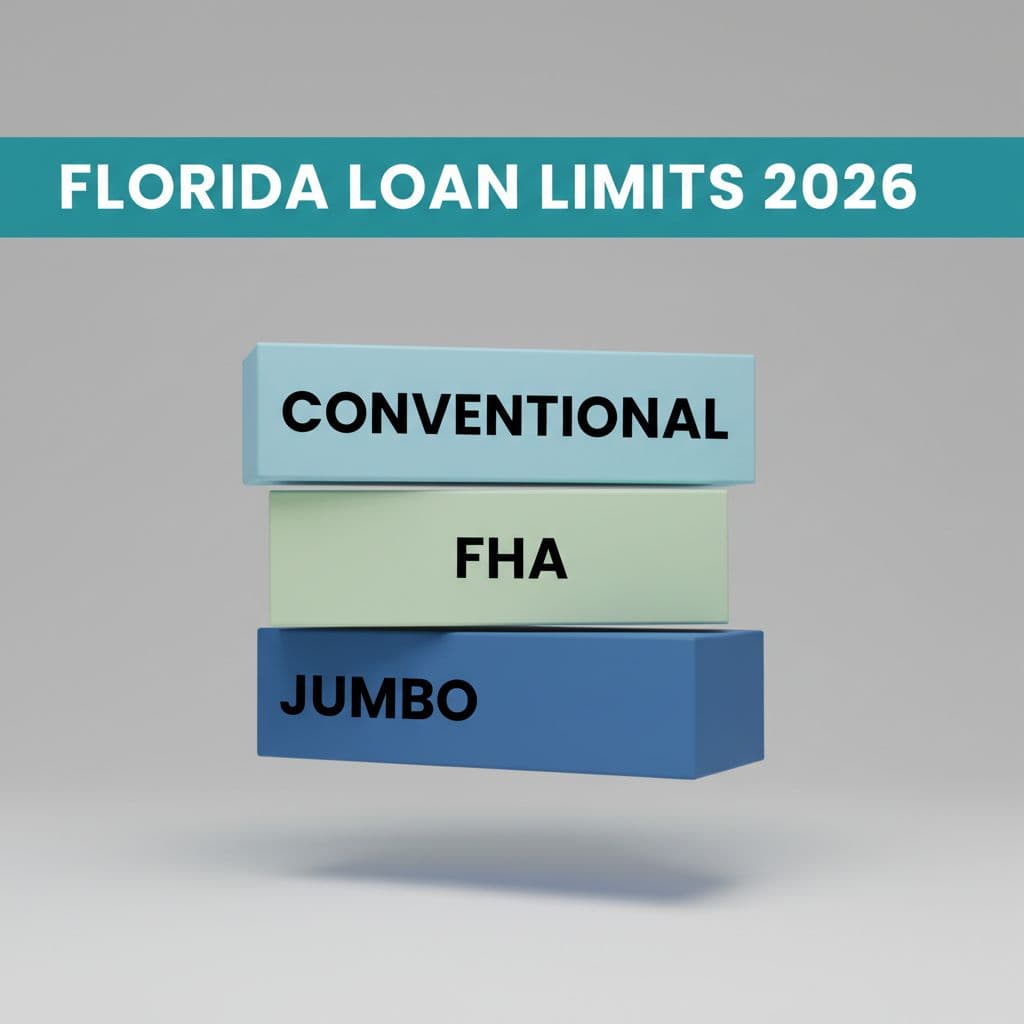
That also means the same loan amount can be treated differently depending on the county. Because mortgage limits vary by location, a $900,000 loan is considered jumbo in most of Florida, but not in Monroe County. That is why county-level detail matters before you assume you need a specific jumbo product.
One more detail matters here. These figures are for one-unit properties. Multi-unit properties have higher limits, so I never use the one-unit number as a blanket rule for every file. If I want to double-check the agency side, Fannie Mae’s loan limit chart is a useful reference.
When a Florida mortgage becomes jumbo
People hear the term jumbo and assume it means luxury. Sometimes it does, but often it simply means the loan amount crossed the local conforming line.
In most Florida counties, a 1-unit loan becomes a jumbo mortgage at $832,751 and up. In Monroe County, jumbo starts at $1,249,126 and up. That is the cleanest way to think about it.
This is also where your down payment strategy starts to matter. A home can have a high purchase price and still avoid jumbo financing if your initial investment is large enough. I have seen buyers assume they needed a jumbo mortgage because the house price looked high, when a quick loan amount calculation showed the opposite.
The number that decides the category is your loan amount after your down payment, not the price on the listing.
FHA is different. If the loan amount goes above the FHA cap in your county, it does not become a normal jumbo FHA loan for most Florida buyers. It means FHA is no longer the lane for that amount, and I start looking at conventional or jumbo options instead.
These loans also come with their own personality. I usually expect tighter credit standards, larger reserve requirements, and a closer review of the property. Lenders will also pay significant attention to your credit score and the current interest rates for these high-balance files. If the home is a condo, the building itself can become part of the story, especially near the coast.
Why the limit is only the first filter
This is where buyers often get tripped up. A loan can fit the Florida mortgage limits and still fail to close.
I see this happen when taxes, insurance, and association dues are estimated too low. In Florida, that mistake becomes expensive quickly. Wind coverage, flood insurance, condo dues, and special assessments can increase the monthly payment much more than buyers expect. Because lenders use the total housing expense to calculate your debt-to-income ratio, these underestimated costs can disqualify a loan that otherwise looked solid on paper.
For investors, the same challenge appears in a different way. The property still has to make financial sense to a lender. They examine the full housing expense, which includes taxes, insurance, and monthly dues. If the math is tight before closing, it usually looks even tighter afterward.
Cash reserves are another critical factor in mortgage qualifying. Lenders often want to see liquid funds remaining after closing, specifically enough to cover several months of mortgage payments. That financial cushion matters for primary homes, second homes, and rentals, though it becomes even more vital when securing jumbo loans.
The specific property type also deserves extra attention in Florida. I have seen perfectly nice units run into trouble because the association had deferred maintenance, unresolved structural issues, or insurance terms that made underwriters nervous. High master-policy deductibles, pending roof work, balcony repairs, water intrusion, and concrete restoration can all slow a file down, regardless of the loan size.
So yes, the loan limit matters. But it is only the first gate you must pass.
How I tell buyers and investors to shop smart in 2026
I keep this part simple.
First, I check the specific county, as navigating the unique requirements in a high-cost county like Monroe County requires extra diligence. Second, I calculate the loan amount after the down payment. Third, I run the real monthly payment with taxes, insurance, and any HOA dues included. That tells me much more than a listing price by itself ever will.
That approach saves time, and it saves disappointment. It also tells me early whether I am looking at FHA, conventional, or jumbo financing.
If income documentation is the real problem, the limit may not be the issue at all. I work with plenty of self-employed buyers whose tax returns look thin because of write-offs, even when the business is healthy. In those cases, bank statement loans for self-employed borrowers can be a better fit than forcing a conventional file that does not tell the full story.
Some buyers have a different option entirely. If you are eligible, the Southwest Florida VA mortgage guide is worth reading because VA financing does not follow the same structure as the programs in this article. And if you want the quick version on down payments, documentation, and common process questions, our mortgage frequently asked questions page is a good place to start.
When I talk with buyers before they shop, the goal is not to guess. It is to know the lane before falling in love with the house. If you want help sorting through county caps, current mortgage rates, or available refinance options, Contact Us for a free consultation on your financing needs.
Frequently Asked Questions
Does a higher home price automatically mean I need a jumbo loan?
No, the classification depends on your loan amount after your down payment is subtracted from the purchase price. If you make a large down payment that brings your loan balance under the local conforming limit, you may still qualify for a conventional or FHA loan even on an expensive property.
Why are the loan limits in Monroe County higher than in the rest of Florida?
Monroe County is classified as a high-cost area due to the local median home prices in the Florida Keys. The government adjusts limits annually to ensure that financing remains accessible for residents in markets where real estate costs significantly exceed the national average.
What happens if my loan amount exceeds the FHA limit?
If your required loan amount exceeds the FHA limit for your county, you cannot simply use a jumbo FHA loan because such a product does not exist in the same way. Instead, you must pivot to conventional financing or a private jumbo mortgage, which will have different credit, reserve, and underwriting requirements.
Do higher loan limits exist for multi-unit properties?
Yes, the loan limits discussed for single-family homes are for one-unit properties. If you are purchasing a multi-unit property, such as a duplex or triplex, the conforming loan limits are higher, allowing for more substantial financing.
Conclusion
Understanding Florida loan limits for 2026 becomes much simpler once you strip away the industry noise. In most Florida counties, the conventional conforming loan limits are set at $832,750 for a single-unit property, while the baseline FHA loan limits sit at $541,287. Notable exceptions exist in areas like Monroe County, where costs are higher, and it is important to remember that any financing exceeding your local conforming cap is classified as a jumbo mortgage.
The bigger point is this: a successful mortgage strategy involves more than just clearing the limit. Your financing plan must align with your specific down payment, your target monthly budget, your chosen property type, and the way your income is documented. When those pieces align, selecting the right loan becomes a much more straightforward process.